To see Jesus is to see God
The Necessity Problem
If you grew up believing God loves you but could never quite shake
the feeling that he's holding something back, you're in the right place.
That unease isn't weak faith; it's a reasonable response to a picture of
God who cannot forgive until someone is punished. There is no God hiding
behind Jesus, and this site is my attempt to show you where that hidden
God came from.
The theory you're likely bothered by is called penal substitutionary atonement,
and it claims God is unable to simply forgive. Not
unwilling, but unable. That inability is about our guilt, and our guilt did
not exist until we made it. This is a study of what seventeen centuries
of careful people did with that problem.
New here? Start with the drift.
And as a note: if this season has been heavy, not just
theologically, but emotionally and spiritually as well, don't carry it by
yourself. Find a trusted friend or a counselor. That'll be of greater value
than anything I'll be able to say here.
Where to go
-
Interactive
The drift of the claim
Watch how the constraint moves. It starts outside him and travels in; once inside, it stops moving and starts dividing him; and at the end the ground drops away and only the bare claim is left standing.
-
The short version
Short essay
The whole argument in plain terms: penal substitution needs God to be unable to forgive, that inability is about our guilt, and our guilt did not exist until we made it.
-
The full essay
The Necessity Problem
The complete argument, with the historical apparatus laid out: how the constraint on God migrates from the will to the essence across seventeen centuries, and why every move leaves its object untouched.
-
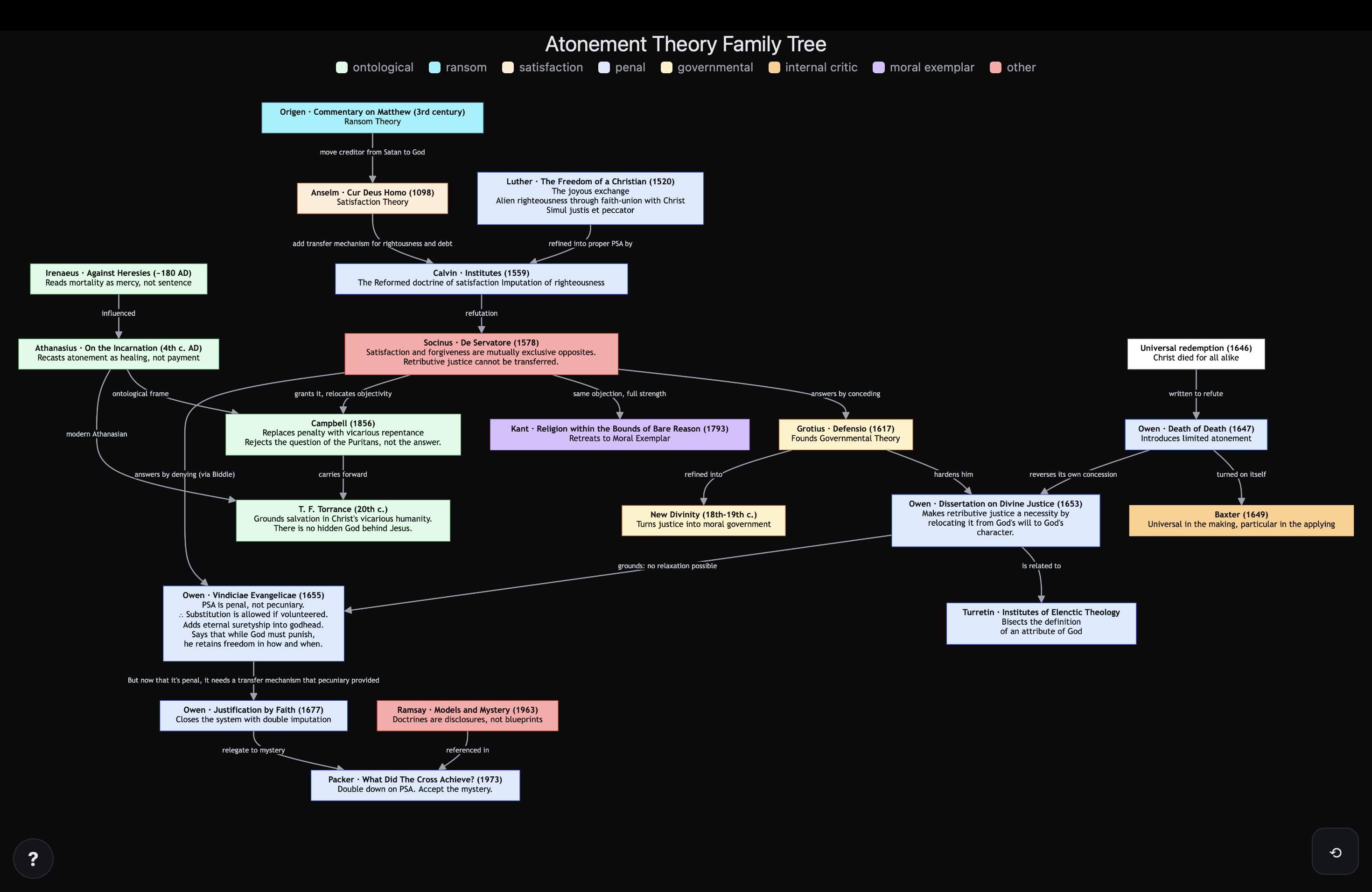
Interactive
The family tree
Every position as a box, every arrow a pressure — what refutes what, what concedes to what, what hardens in response to what. Tap any box for the problem it faces, the move it makes, and the new problem that move opens.
-
Primary source
Reading Athanasius
On the Incarnation in four editions, from the 1911 Robertson translation to a lightly modernised ePub. The soft landing for anyone who has only ever heard the gospel in a penal frame.
The argument in brief
Penal substitutionary atonement requires a constraint on God that did not exist before the fall — a necessity God acquires when the creature sins. Before there is guilt, nothing obliges God to punish. After there is guilt, he cannot do otherwise.
And it has nowhere to sit. Housed outside God, it insults his sovereignty: something that is not God now binds God. Housed inside him, it damages his nature: an attribute that is essential yet has no object until a creature sins is an unrealised capacity in a being who is supposed to have none.
So the constraint migrates, and it migrates one way. Every move operates on the modality of the constraint — whether the “must” is absolute or hypothetical, whether it sits in the will or the essence — while leaving its object untouched. In every location the object is creaturely. The defect was always in the object.
If this feels like it’s pulling a thread you can’t afford to lose
Rejecting penal substitution can feel like abandoning your faith. It doesn’t have to be. Start with Athanasius’ On the Incarnation — the ontological account is the soft landing for anyone who has only ever heard the gospel in a penal frame. This project exists because it’s what let me keep my faith, not lose it.